Sortie de Kerouac et la Beat Generation, une enquête, de Jean-François Duval.


Fiche technique du livre : 

Sortie : 2 mai 2012
Prix : 23.00 € (21.85 € sur Amazon, lien ici)
  • Broché: 328 pages
  • Editeur : PRESSES UNIVERSITAIRES DE FRANCE - PUF (2 mai 2012)
  • Collection : PERSPECTIVES CR
  • Langue : Français
  • ISBN-10: 2130592953
  • ISBN-13: 978-2130592952


Présentation de l'éditeur : 
Jean-François Duval sillonne depuis vingt ans les États-Unis sur la piste de Jack Kerouac et des héros de la Beat Generation, avec en ligne de mire notamment la figure charismatique de Neal Cassady, le héros de Sur la route. Il a retrouvé et s'est entretenu avec plusieurs protagonistes majeurs de la légende beat : Allen Ginsberg, Carolyn Cassady, Joyce Johnson, Timothy Leary, Anne Waldman, Ken Kesey. Sous une forme très vivante, il nous livre ici les résultats de son enquête. Enquête sur Kerouac et la Beat Generation rend justice à un écrivain phare et à un mouvement dont l'impact social et littéraire est beaucoup plus important qu'on ne le pense généralement. L'ouvrage fait revivre de l'intérieur l'épopée des « Beats » au travers de témoignages de première main. Il montre comment le succès d'un livre culte, Sur la route, peut conduire à la déchéance et à la mort voulue à la fois de son auteur, Kerouac, et de son héros, Neal Cassady, tous deux victimes de leurs propres accomplissements. Il montre aussi que la contre-culture américaine, tout au long de la seconde moitié du XXe siècle et jusqu'à aujourd'hui, sans même que nous en ayons conscience (c'est-à-dire bien au-delà des signes apparents que sont le port du blue-jean, l'absorption de coca-cola et les influences musicales), représente la face cachée d'à peu près toutes les évolutions culturelles que nous avons connues en Europe. L'histoire des « Beats » est aussi notre histoire. Avec une riche iconographie, un Who s Who, des repères chronologiques et bibliographiques.


Présentation du livre par l'auteur : 


Quelques extraits d'entretiens réalisés par Jean-François Duval  : 


Entretien avec Carolyn Cassady

Entretien avec Allen Ginsberg

Entretien avec Joyce Johnson

Entretien avec Ken Kesey

Entretien avec Timothy Leary

Entretien avec Anne Waldman


Evénement en partenariat avec les éditions PUF prévu cette semaine ! 


Source : dossier de presse du livre.


Lire La Suite...

Table de ronde autour de Sur La Route : le compte-rendu !


Le compte-rendu de la table ronde consacrée aux road-movie et au nouveau film de Walter Salles, Sur La Route ! 


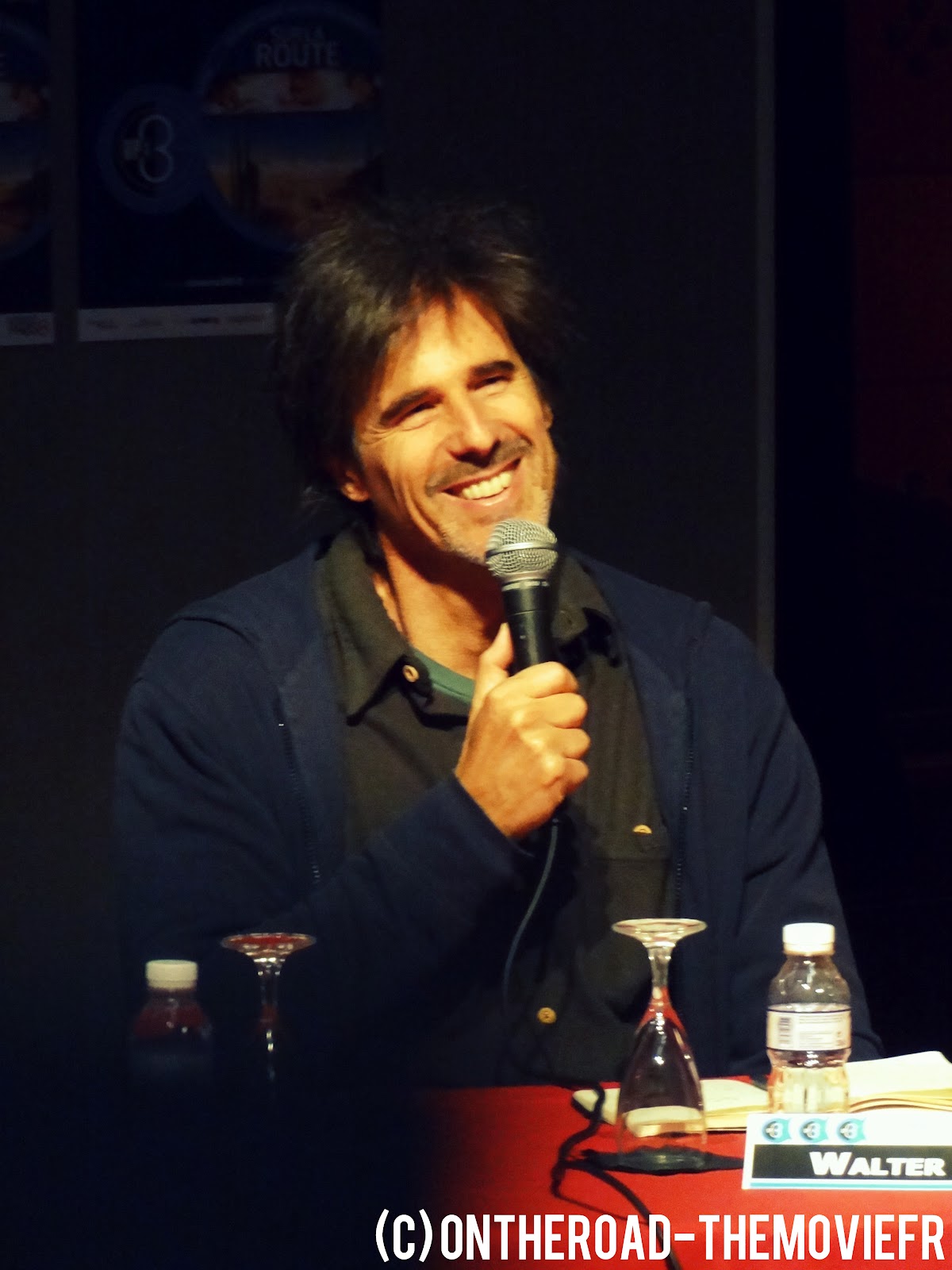
      Jeudi 19 avril, 15 heures tapantes. Walter Salles, Olivier Archambeau, Cloé Korman et Brieux Ferot entrent en scène. Habillé simplement, Salles lance à l’amphi de grands sourires, avant de commencer à répondre aux questions des invités. Première remarque : pas le moindre petit accent ne vient perturber l’exposé qu’il fait...en français. Quelques expressions lui échappent parfois et c’est avec plaisir qu’il fait participer la salle pour l’aider à combler ses quelques lacunes. Un véritable échange s’installe alors et le public intervient désormais spontanément, au fil du déroulement des réponses du réalisateur. Ce dernier cite souvent Carnet de voyage, mentionne quelque fois Sur la route. Une certaine électricité se fait sentir à l’entente du film désormais en compétition officielle pour Cannes. Salles ne développe pas trop, le modérateur précise à plusieurs reprises qu’il faudra attendre la 2° partie de l’intervention consacrée spécifiquement au film. Tendu, le modérateur ? Il avait fait part plus tôt dans l’annonce de la partie consacrée à Sur La Route, la possibilité pour les spectateurs de poser ‘’ des questions sur le casting’’ et l’on sentait poindre un mélange de lassitude et d’agacement dans sa voix. Mais qu’il se rassure. Les personnes présentes dans l’amphi X ce jeudi 19 avril ne sont pas des fans avides d’anecdotes sur leurs acteurs favoris, mais bien plutôt des étudiants en cinéma, des passionnés de la route ou encore des étudiants brésiliens résidant en France venus spécialement pour rencontrer ce réalisateur extrêmement populaire dans leur pays. Alors certes, l’inévitable question ‘’pourquoi avoir choisi tel ou tel acteur’’ est apparue, mais ce fut tout. Le reste s’est concentré sur la manière dont Salles à appréhendé l’adaptation du film, à son rapport avec le genre du road movie… une belle leçon de cinéma par un réalisateur de talent qui dit les choses en toute humilité.


  •  Brieux Ferot, modérateur,  Walter Salles, cinéaste, Olivier Archambeau, maître de conférences à l’université Paris 8, Cloé Korman, écrivaine


  • Là où commence la route…


    Le premier souvenir d’enfance de Walter Salles remonte à ‘la lucarne d’une voiture, d’où j’aperçois la route. Plus tard vient la lecture de Sur la route, à 18 ans. Il se souvient que le livre, interdit au Brésil à cette époque, circulait de mains en mains en version originale. L'histoire de Sal et Dean a un écho particulier pour lui, dans le contexte de crise et de dictature militaire que vivait alors le Brésil. L'intérêt pour le genre du road-movie lui vient donc de cette période, de cette 'quête d'un futur possible'. Ayant commencé par réaliser des documentaires, Salles précise que l'intérêt pour le genre du road-movie s'inscrit plus globalement dans la tradition du documentaire brésilien, celle de cartographier de nouveaux horizons, de 'nommer ce qui n’a pas été nommé.' (Borges).


    Accident, fuite et nostalgie.


    Accompagné de l'invité Olivier Archambeau , Walter Salles se penche ensuite sur les différentes composantes du road-movie : accident, fuite et nostalgie.

    L'accident tout d'abord, car 'sur la route, tout se modifie'. Salles donne quelques conseils aux futurs réalisateurs : ''Plus un scénario est bâti, plus il est facile de s'en éloigner. C'est un peu comme le jazz. Si vous connaissez la mélodie, vous pouvez partir dans des solos impensables parce que vous allez réussir à retrouver ce noyau, plus tard.'' L'improvisation est ce qui est au cœur du road-movie, ce qui en fait sa force. Walter Salles prend l'exemple du film Terre Lointaine, qui vient d'être projeté avant la conférence. Il raconte en effet avec émotion que la fin du film ne lui a été soufflée qu'au moment du tournage, alors que l'actrice principale, Fernanda Torres, chantait Vapor Barato, de Gal Costa. Ce qui n'était à l'origine qu'une chanson fredonnée entre deux prises s'est retrouvée le superbe final du film, interprétée par l'actrice elle-même.

     L'accident est paradoxalement un choix du réalisateur avant-tout, celui de prendre le risque d'intégrer cet élément inattendu au film. Cette situation d'improvisation, d'abandon, Salles explique qu'elle est essentielle pour le bon fonctionnement d'un film. Il faut arriver à amener les acteurs à cet état, pour parvenir au moment où ils vivent le film et oublient leur jeu. Pour cela, il organise en amont du tournage une préparation afin que les acteurs apprennent à se connaître et étudient le contexte et l'histoire qu'ils vont interpréter. Ils travaillent dur avant, répétant leurs répliques, de sorte qu'ils puissent s'en libérer au moment du tournage. C'est ce qu'il a fait pour ses précédents films et qu'il a continué avec Sur La Route en organisant le fameux 'camp Beatnik'.

    La fuite, ensuite. La fuite en avant des personnages se mêle à la nostalgie qui les étreint. ''Sur la route, on se laisse emballer par ses sentiments, on a le désir d’inconnu.''


    On the road Walter !


           En 2004, lorsque l'on propose à Walter Salles de réaliser l'adaptation cinématographique de Sur La Route, celui-ci ne se sent pas près. ''J'avais un rapport très charnel avec le livre, mais en décalage culturel.'' Il entreprend alors une traversée des Etats-Unis à la manière de Kerouac, réalisant au passage des interviews avec les figures caractéristiques l'ayant cotoyé, comme Laurence Ferlinghetti ou Carolyn Cassady. Au total, il aura fallu six ans et quelques 100 heures de film - que Salles est en ce moment en train de monter pour réaliser un documentaire (Looking for On The Road)-  pour que le tournage du film débute. En parallèle, l'équipe technique et le choix des acteurs s'est lentement constitué. Kirsten Dunst a été retenue la première pour jouer le rôle de Camille, que Salles trouve 'd'une grande justesse'. Puis Gustavo Santaolalla et Alejandro Inarittu l'appellent pour lui dire d'arrêter de chercher pour le rôle de Marylou. Ils viennent en effet de regarder un premier montage du film Into The Wild (Sean Penn), et Kristen Stewart leur semble être la parfaite Marylou. Reste Dean Moriarty et Sal Paradise. Garrett Hedlund est retenu pour le rôle de Dean et Sam Riley, repéré dans Control, pour celui de Sal. Certains pourraient penser que le choix du casting s'est fait d'une manière bankable, Salles fait remarquer au contraire que celui-ci était à l'origine incognito, les acteurs ayant été retenu avant l'explosion de leur carrière, notamment Kristen Stewart, révélée au grand public avec la saga Twilight, un an environ après la décision de Walter Salles de la faire incarner Marylou.

    Plutôt que de vouloir rester scotché au livre, Salles explique que pour rendre le plus justice à la liberté qui émane de Sur La Route, il fallait improviser pour lui être fidèle.

    L'intelligence et l'implication des acteurs est également une chose sur laquelle s'arrête le réalisateur. Il raconte ainsi comment Viggo Mortensen a au début pensé décliner le rôle d'Old Bull Lee à cause des 20 kilos supplémentaires qu'il avait du prendre pour le tournage d'un autre projet. Et comment il a réussi à les perdre en un temps record par la suite et a apporté sur le tournage les livres de Céline, la machine à écrire... et l'arme de Burroughs (Old Bull Lee dans le livre). 
    Ou encore Sam Riley qui écoute du ''jazz à fond pour être synchro dans la scène où on le voit taper à la machine à écrire.''

    Au cours des 100 000 km parcourus pendant le tournage, les conditions ont parfois été très dures. Salles n'a pas voulu utiliser de bluescreen et a dû aller chercher les paysages enneigés qui lui convenait. Il ajoute même avec humour après le visionnage de la bande-annonce du film : ''on n'a jamais brûlé autant de joints que dans ce film !''


    Retour aux sources : Kerouac.


          Salles donne enfin sa vision du livre. Pour lui, Sur La Route renvoie à l'interrogation ''qu'est-ce que ça signifie d'être jeune ?'' Le livre retrace la route de Sal, à travers son regard et les choix qu'il opère pour raconter son périple. ''Kerouac ne juge pas les gens, c'est un passeur, pas un voyeur.'' La plus belle récompense de Salles sera alors que les gens qui n'ont pas lu le livre de Kerouac puisse le découvrir...et s'y plonger par la suite.


    Un grand merci à l'université Paris 8 et à l'association Super 8 d'avoir organisé cette superbe rencontre ! 


    Lire La Suite...

    Jeu- concours 'Sur La Route J-30' !


    Questions/Réponses: 

    1 - Quelle voiture (emblématique de Sur la route) Garrett Hedlund a-t-il conduit de Los Angeles à San Francisco?

    2 - Grâce à sa prestation dans quel film Kristen Stewart s'est-elle vue offrir le rôle de Marylou? 


    3 - Qui se cache (dans la vraie vie) derrière le personnage de Sal Paradise qu'interprète Sam Riley?


    4 - En combien de temps a été écrit Sur la route?

    5 - Où étaient Garrett Hedlund, Sam Riley, Kristen Stewart et Gerald Nicosia lors de cette photo?


    Jeu ouvert du lundi 23 avril au dimanche 29 avril 23h.


    Conditions/Règles de participation:
    - Envoyer les réponses à jeuconcoursotr@yahoo.fr
    - Une participation par personne
    -Vivre en France, Belgique ou Suisse
    - Indiquer son nom/prénom + adresse postale dans le mail (tout mail incomplet sera refusé)


    Bonne chance à tous ! 


    Lire La Suite...

    Interview de Walter Salles pour SUR LA ROUTE - Blog brésilien.


    ''The anticipation is over: On the Road, Walter Salles, competes for the Palme d’Or, the top prize at Cannes, the most famous among film festivals. The Brazilian title [Na Estrada] is a literal translation of On the Road, Jack Kerouac’s beat novel, which influenced the behavior of several generations of young, anticipated the 1960s hippie spirit and revolt and lead the way to inspiring most writers of the second half of 20th century – and not just in the United States.
    It fell on Walter Salles to bring to the screen adaptation of such NorthAmerican but universal journey of On the Road with its three young characters: the writer Sal Paradise (Sam Riley), whose life begins to boil with the the arrival of Dean Moriarty (Garrett Hedlund) , a young libertarian from the West and his girlfriend of 16 years Marylou (Kristen Stewart). The film’s cast includes such names as Viggo Mortensen, Steve Buscemi and Brazilian Alice Braga and it premieres in Brazil on June 15th.
    On multiple instances, studios had attempted to adapt this important novel to the big screen. To be exact, there have been ten attempts and they have all failed. It comes to us now at the hands of this Brazilian, who is so fond of road movies that he’s made multiple movies in this genre such as Foreign Land, Central Station and The Motorcycle Diaries. Now leads, as director, the genre prototype,  a project full of challenges as he describes in the interview below, exclusive to Caderno 2.
    Let’s start at the beginning: the novel. Critics say it was a revolution in American culture, of the same extend of The Catcher in the Rye, or even greater. Do you agree? Why? 
    Yes, it was a shock. On the Road was a watershed due to the radical freedom that its characters announced, the narrative rhythm of jazz and the bebop, the drugs used as a means of increasing knowledge of the world, the way sex was experienced and described with such intensity. On the Road laid the roots of a behavioral revolution, the beginning of the American counterculture, and marked the arrival of a new generation of brilliant writers. But the book was far from unanimous. Truman Capote, for example, said that it was not literature, but typing. Gore Vidal was the same way, as John Updike. The same split occurred with critics. 
    How was the challenge of filming the “American institution” which had been attempted to be taken to the big screen since its release in 1957? 
    Its significant than more than ten projects have been developed and shelved all these years, and that no U.S. producer has ventured in this task. The Beat Museum in San Francisco is doing a seminar next month on the theme “On the Road X Hollywood” to understand the reasons for this mismatch. The film ended up being possible thanks to the French independent production company MK2, which financed the project with the help of English Film Four and small independent European distributors who pre-bought the film. The Zoetrope is the co-producer of the film, and it was through them that the invitation came shortly after the screening of The Motorcycle Diaries, in 2004, at Sundance. 
    Did you feel, as a Brazilian, the freedom to deal with the novel, ultimately so deeply American? Or did you think there were universal points of interchange? If so, what would they be? 
    When I was approached, I wasn’t sure whether to accept it or not. I was deeply touched by On the Road which I read for the first time in 1970. The book was totally different from what I had read so far, unlike the world in which I lived. Nothing else would be as it was before. But that wasn’t a passport to adapt it, and that’s why I proposed to Zoetrope make a documentary that began in the search of On the Road and Kerouac’s legacy. This process was fascinating, to make a documentary in search of a possible movie, and filmed intermittently over the past six years. One of our interviewees was the poet and political activist Amiri Baraka. Baraka reminded us that On the Road was first of all, the story of young children of immigrants in the United States, which came from Quebec (Kerouac), Eastern Europe (Ginsberg), Ireland and Germany (Neal Cassady). These young people didn’t have a place in the American conservative culture of the postwar period, and came into collision with her. The understanding that the works of Kerouac and Ginsberg are “between cultures” opened up, somehow, the possibility of seeing the country from outside. 
    There is certainly something that attracts us to the road movies as evidenced Foreign Land, The Motorcycle Diaries and also, of course, Central Station. These films are about displacement, both physical and existential. Your familiarity (and preference) with them prepared for the On the Road and in what way? 
    The question of the search for identity is perhaps the common thread to most of the movies I’ve made, and road movies yield themselves to this thematic. Moreover, the films of the road are those in which the improvisation is required at all times. If it snows, you change the script to incorporate the snow. If we arrange for a young guide to shows us and tells us Cuzco of the Incas and the unable (Spanish), in The Motorcycle Diaries, we incorporate it into the narrative. The road movie is the meeting point of the documentary film, where I come from, and fiction. 
    Another thing was the documentary that you previously did, and we saw a stretch, Searching for the On the Road. How did you prepare to face the challenge of Kerouac’s fiction? 
    I wouldn’t have made the film without going through the documentary. It allowed us to find the book’s characters who are alive, allowed us to find several poets of the generation Kerouac who formed the Beat movement, and artists who were influenced by the work of the writer. Each one of these people, we asked what was the movie that they want to see based on On the Road. These responses were guiding us, opening track, allowing to understand how this story neared Rashomon. For every fact, there was a series of possible versions of how to interpret it. It was a fascinating process that fed us through the entire time. 
    How did you do the casting? And the technical staff? 
    Most of the cast was asked early in the process, five years ago. Kirsten Dunst was the first person I was talking to for Camille. Garrett Hedlund appeared to the audition, coming directly from the farm where he lived in Minnesota, near Fargo, the city where the Coen brothers filmed. He brought a text about the trip he had made. It was as remarkable as his audition. Sam Riley also did a great test after I’ve seen Control, and was charmed by his performance as Ian Curtis. Kristen Stewart was invited almost as soon as Kirsten Dunst, thanks to Gustavo Santaolalla and Alejandro Gonzalez Inarritu, who had seen the first cut of the film by Sean Penn, Into the Wild. They said to stop looking for Marylou, because we just saw a girl of 16 years that was perfect for the role. I remember I had to write at the time the name of Kristen.
    When the film became a reality, we ended the casting process and that’s where actors like Viggo Mortensen, Amy Adams, Steve Buscemi and Alice Braga joined the movie. Viggo arrived with the clothes of the character, the typewriter, revolver identical to the one used by Burroughs. He also suggested a series of additional scenes, which improvise in New Orleans. Amy Adams is an exceptional actress, of the same caliber as Viggo. And Alice entered with heart and soul into the film, giving life to a luminous character, just as I had imagined.
    The technical team is largely the same as the Motorcycle Diaries. The screenplay by Jose Rivera, light and camera Eric Gautier, art direction by Carlos Conti and soundtrack by Gustavo Santaolalla. 
    How do you solve the problem of translating into the big screen the rhythm that one feels when reading Kerouac, that fast pace, frenetic rhythm? 
    It’s a film that alternates moments of acceleration with moments where the time seems to stand still to accentuate the pain felt by the characters. It was essential to do justice to the spontaneity, improvisation featured in the text. The writer Roberto Muggiati says that the typewriter was, for Kerouac, an extension of his own body. And he dedicated himself to it through long periods just like saxophonist improvising. It was necessary to replicate that intensity in the movie. 
    The book is symptomatic of that time, 1950, immediately after the war, a generation lost, the beatnik age, the pre-hippie, pre-political movements of 1968. How do you think that this material binds to our current era, which seems more about lukewarm disillusionment than anger? 
    On the Road preaches the importance of living intensely, with a bare soul, and not by proxy. The opposite of reality-TV. It still makes sense to move, see with your own eyes a moment in which time and geography implode,  like Jia Zhang-Ke shows splendidly in “The World”? One possible answer: In recent years, several times I went to Patagonia to shoot or do locations. I experienced the cold, the dryness, I felt infinitely small in the middle of that immensity. It all this creates an unforgettable relationship with that environment, the opposite of what would have happened if I had had the experience of geography by looking at that screen television. Nothing replaces experience. 
    How did you choose the locations, which seem to be really important in recreating the ambiance of those years and that type of mentality?  
    It was far more difficult than for The Motorcycle Diaries, because Latin America is still, in many respects, a last frontier. To make On the Road, we had to film three or four times more, and longer. In total, 100,000 kms to try to find a virgin geography, who could convey the idea these young people were in search of the last American frontier. For this, we needed to constantly divert urban centers that today seem all trivialized by Wal-Mart and McDonalds. 
    The beats planted the seeds of a behavioral revolution that somehow created the world we live in today. Is  their message not to be diminished int his world of ours, already aged and that isn’t astonished by anything? Or do they retain their power of corrosion? 
    On the Road started a revolution whose behavioral reflection can be felt today. Eduardo Bueno is right in remembering there would be no Bob Dylan without On the Road, there wouldn’t be Leonard Cohen nor Neal Young without the Beat poets. As of lately, we live the same culture of fear as during the years of McCarthyism. Are we really so far away from that era? In some ways, yes, in others not. It was this insight that made us pursue a movie that wasn’t placed in a distant time, and that was  contemporary. 
    In terms of international distribution: it’s part of the Cannes Film Festival, does the  film already have a world premiere date? And in Brazil? 
    The film opens in France and several European countries on May 23. Other premieres will take place until late September, when the film comes to England. In Brazil, the debut will take place on June 15. 
    Do you think the film will be understood differently in the U.S., in Europe and Brazil? 
    Yes, the same way that The Motorcycle Diaries was understood differently depending on the latitude. The interpretation of Diaries couldn’t be the same in Argentina, Cuba or the United States. Similarly, one should imagine the interpretation of On the Road to vary widely from Europe to the United States, or Latin America. It is important to note, however, that countries like France and Italy embraced early Kerouac, Ginsberg and the Beat poets, as they also did with the jazz musicians of the 40s, when those same poets were not yet recognized in its country of origin. More specifically with respect to Kerouac, writer Barry Gifford, author of an excellent oral biography called “The Book of Jack” reminds us in the late ’70s and early ’80s was hard to find books in bookstores Kerouac U.S. . In Europe, the opposite happened. 
    As an author, did you have total freedom to do the film how you deemed best or did you have any pressure the production side? 
    The film was independently financed by French producer Mk2,  by Film Four (the same company that had independently funded British Motorcycle Diaries) and the pre-purchase made ​​possible by several small European distributors. In the same way it happened with Dairies, I made the final cut of the film. The greatest difficulties were linked to the budget available to make such a complex movie like this one, but often these limitations worked in favor and not against the movie.''

    (Translation from Portuguese to English by @tELLErized , thank you! )

    Source - Via 


    Lire La Suite...

    Promotion de Sur La Route en France : Walter Salles à Paris le 19 avril et le 26 mai.


    Table ronde autour de Sur La Route en présence de Walter Salles, le réalisateur.


    Quand : le jeudi 19 avril, à partir de 12h30.

    Où : Université Paris 8, Amphi X.
    Qui : Walter Salles 


    ''Réalisateur, scénariste, monteur et producteur brésilien, Walter Salles est un réalisateur du voyage terrestre et imaginaire. Né le 12 avril 1956, l’homme de Rio a commencé sa carrière cinématographique comme documentariste, avant de réaliser sa première fiction, A GRANDE ARTE, en 1991. Il a ensuite signé, en 1995, TERRE LOINTAINE, puis, en 1997, le premier épisode « Le premier jour »pour la série de courts métrages « L’an 2000 vu par.... ».
    C’est en remportant l’Ours d’or à Berlin en 1998 qu’il obtient la reconnaissance internationale, avec le film CENTRAL DO BRASIL. Il réalise ensuite en 2001 le film AVRIL BRISE, avant de produire en 2003 LA CITE DE DIEU, réalisé par son compatriote Fernando Meirelles. En 2004, il réalise CARNETS DE VOYAGE, présenté aux festivals de Sundance et de Cannes, sur l’épopée sud-américaine d’Ernesto « Che » Guevara, avec Gael Garcia Bernal dans le rôle-titre. Il réalisé à Hollywood un thriller, DARK WATER, en 2004, puis quatre ans plus tard, un retour au source avec UNE FAMILLE BRESILIENNE, sélectionné au Festival de Cannes.

    Sa présence à l’université Paris 8 est exceptionnelle, 2012 marquant la sortie de son dernier film, produit par Francis Ford Coppola et attendu depuis de nombreuses années : SUR LA ROUTE, adaptation du roman éponyme phare de Jack Kerouac , dont le casting comprend Sam Riley, Kirsten Stewart et Viggo Mortensen.

    Jeudi 19 avril 2012 : programme de la rencontre avec WALTER SALLES, en Amphi X, à l’université Paris 8

    12H30 Projection du film Terre lointaine (1995)
    15h00 Table ronde autour du film Sur la route (2012)
    En présence de :
    - Walter Salles, cinéaste
    - Olivier Archambeau, maître de conférences à l’université Paris 8
    - Cloé Korman, écrivaine
    - Brieux Ferot, modérateur


    Rencontre à Fnac des Ternes (Paris) 

    Quand : samedi 26 mai à 16h.
    Où : Fnac des Ternes (Paris), forum de rencontres, niveau 4
    Qui : Walter Salles


    EXCLU :

    Je serai présente à la table ronde le 19 avril en présence de Walter Salles qui parlera de Sur La Route.
    Je vous propose de m'envoyer les questions que vous aimeriez lui poser.
    Pour cela, commentez cet article ou envoyez un tweet à @ontheroadthemov avec #ConfWalterSalles, ou encore passez sur la page Facebook (ici) et commentez le statut prévu à cet effet.
    J'essaierai de les lui poser lors de la partie questions/réponses.
    Un grand merci d'avance à tous pour votre participation!

    -N.
    EXCLUSIVE : 

    I will be in Paris to attend the round table about On The Road and meet Walter Salles.
    I thus think it could be cool for you, On The Road fans who live out of France, to have the chance to take part of this, too.
    Send me the questions you would like Walter Salles to answer, and I will try to ask them to him! You just have to comment this article, or send a tweet to @ontheroadthemov with #confWalterSalles , or comment on our Facebook Page here
    Many thanks for your participation !

    -N.


    Lire La Suite...

    Tom Sturridge parle de Sur La Route et mentionne Cannes.


    Tom Sturridge est Carlo Marx dans Sur La Route

    Tom Sturridge talks "On the Road" 

    His next film project is On The Road, the highly anticipated Walter Salles adaptation of Jack Kerouac’s heavily autobiographical and era-defining novel. This May, it’s premiering at Cannes – and Sturridge is hoping to eradicate all memory of his last experience there.
    “Sometimes you go to Cannes with a trailer,” he begins, describing the last time he came to the French Riviera with 2007’s Like Minds. “They held a press conference for this trailer to try and sell the film. It was seven in the morning and the only person who came to the press conference was from Australian Teletext. So my notion of Cannes is a seriously depressing place where bad films are desperately sold.”
    On The Road, is the most ambitious project Sturridge has been involved with to date – not least because it is the adaptation of one of the most celebrated novels in American history, so celebrated in fact that the Americans themselves have long been “too scared to make it,” he remarks. The cast, crew and production of the film have been put together on a truly international scale with funding by Film 4 and French company MK2 Productions. Director Walter Salles is Brazilian, and the cast is balanced between Americans Garrett Hedlund, Kristen Stewart and Kirsten Dunst peppered with Brits Sam Riley and Sturridge, who supports the cast in the role of Carlo Marx. Fans of the novel, will know that Marx is a thinly veiled dramatisation of Kerouac’s real life friend, Allen Ginsberg, but not in the form of the large, balding, hippy that springs to mind when you hear the name.
    “The person I was playing was an 18-year-old guy who hadn’t come out yet, wasn’t the voice of a generation, was confused, shy, intellectually brilliant but sort of socially inarticulate – which is totally against what the world’s thought of him would be,” he says, adding that he had a wealth of material to help him research the historical figure. “His diaries and letters from that period have been published so you can literally go through On The Road the book, work out the scene and go to June 1949 to read his diary. You can find what brand of tea Ginsberg was drinking when he had [a particular] conversation.” You might think all this would be incredibly helpful for an actor who was determined to give a good performance, however the materials were almost a hindrance instead of a help, says Sturridge. “I read everything,” he begins. “Every piece of poetry he wrote up until that age, all his diaries. I read biographies, I read so much stuff but remembered on the first day of filming that I wasn’t trying to become a Ginsberg expert, I was trying to play a character. I remember shooting a first scene and them saying “action!” and thinking “fuck! I’ve totally forgotten to sort of… read the scripts!” I can tell you all sorts of things about Ginsbergs dietary feelings in this period in time but have no idea how to say these lines.”

    The film itself has effectively been in production since the rights were bought by Frances Ford Coppola in 1979 (Coppola is an executive producer on the project). Attempts stalled until Salles came on board, shortly after completing his own road trip epic, The Motorcycle Diaries. However even with the right talent behind it, it was still a little longer before the film finally went into production in the latter half of 2010 – but the role of Marx was one that Sturridge was determined to bag.
    “I did an audition for Walter and it went well. But that was three years before it got made. And then I found out from friends that it was being made again and I knew Walter was in New York so I pretended that I was in New York, when in fact I wasn’t,” he says. “I arranged a meeting with him, and then flew to New York to be like “hey! I was here the whole time, just passing by” and had lunch with him and we talked.”
    After going to all that effort to get the part, does he feel he did it justice? Well, yes, but he doesn’t seem to be the sort to torture himself unnecessarily about his craft. “It’s acting,” he says with a smile. “I’m not fucking up surgery. No one’s getting killed.”

    Traduction FR à venir.

    Source - Via 
    Lire La Suite...

    Joyeux anniversaire Walter Salles !

    Le mois d'avril est le mois des anniversaires parmi l'équipe d'On The Road, puisque c'est aujourd'hui l'anniversaire de Walter Salles, 3 jours après celui de Kristen Stewart.  
    On souhaite donc le meilleur au réalisateur d'On The Road pour sa 56° année ! 


    Lire La Suite...

    Une photo de Walter Salles avec le journaliste Eduardo Bueno.


    Cette photo, prise hier dans le cadre d'une réunion, montre Walter Salles, réalisateur de Sur La Route, avec  Eduardo Bueno, qui a notamment traduit Sur La Route en portugais.


    Petite anecdote : le tee-shirt d'Eduardo Bueno reprend l'esquisse d'une couverture de Sur La Route faite par Jack Kerouac en personne lors de la sortie du roman en 1952. La couverture n'a cependant jamais été éditée.


    Source

    Lire La Suite...

    Joyeux anniversaire Kristen Stewart !

    Joyeux anniversaire Kristen Stewart ! 

    Toute l'équipe d'OnTheRoad-TheMovieFR et l'ensemble des fans de Sur La Route souhaitent un très bel 22ème anniversaire à Kristen Stewart, qui interprète Marylou dans Sur La Route

    Vous aussi, laissez un message à l'intention de Kristen dans les commentaires, ou par twitter en utilisant #kristenroute22bd !


    Lire La Suite...