Affichage des articles dont le libellé est Compte-rendu. Afficher tous les articles

Compte-rendu de la projection de SUR LA ROUTE à Los Angeles.


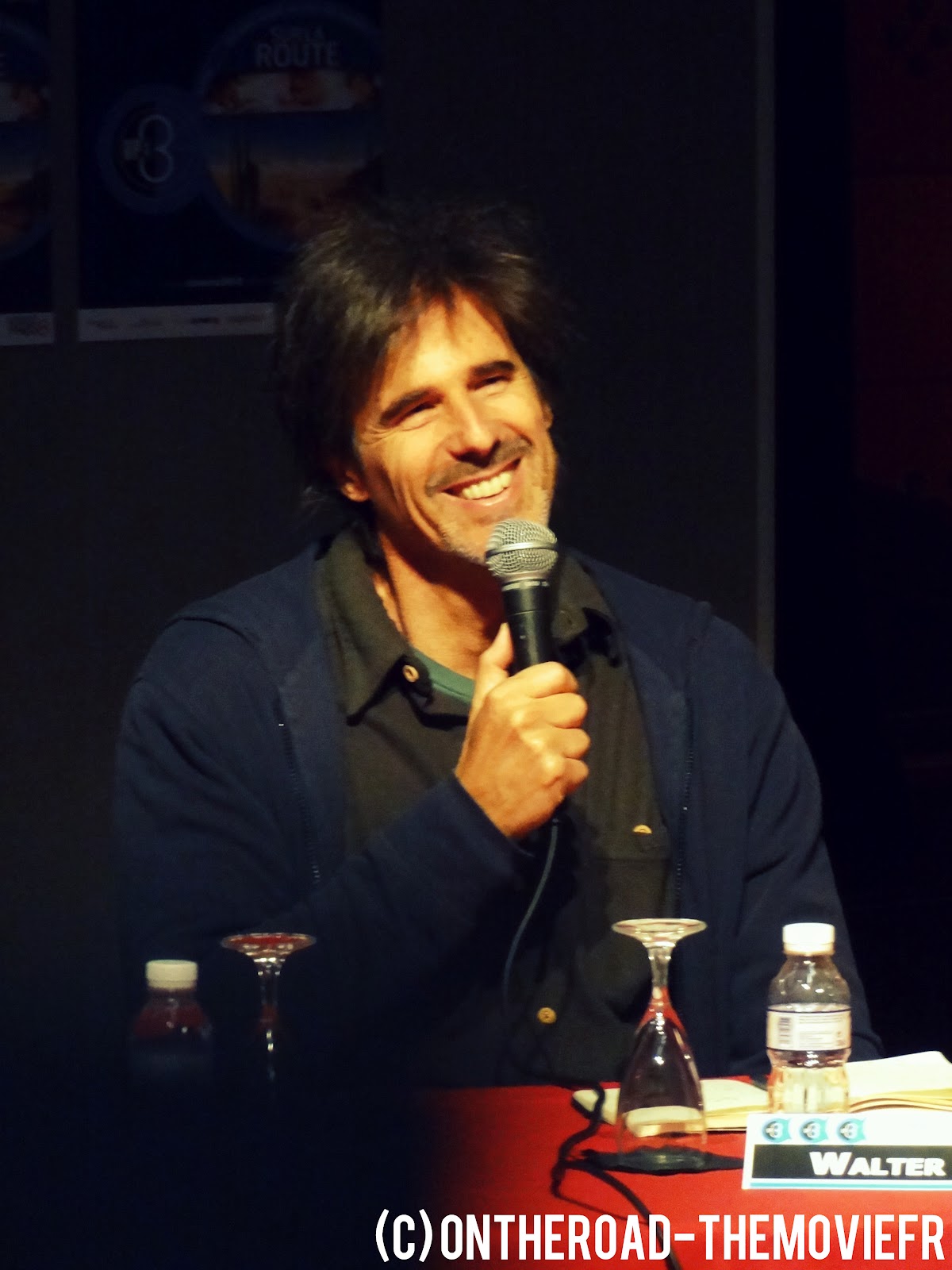
Compte-rendu de la session questions/réponses en présence de Walter Salles et Garrett Hedlund qui a suivi la projection du film à Los Angeles, ce mercredi 5 décembre.


On y apprend notamment que le documentaire tourné en préparation du film et qui retrace cinq années de recherches sur les traces de la Beat generation, 'Looking for On the road', devrait être fini au ''début de l'année prochaine'', selon Walter Salles. 


Walter Salles and Garrett Hedlund at TheWrap's screening of On The Road.

'On the Road' Director and Star Talk Kristen Stewart, Steve Buscemi Gay Sex Scene
By Tim Kenneally


Jack Kerouac's seminal Beat Generation novel "On the Road" might revolve around the spontaneity of youth, but the film that it spawned certainly had more than its fair share of preparation behind it. 
After TheWrap's screening of "On the Road" at the Landmark Theatre in Los Angeles on Wednesday night, director Walter Salles and star Garrett Hedlund -- who plays iconic Beat Generation figure Dean Moriarty in the film -- discussed the long journey that went into bringing Jack Kerouac's novel to the screen.

In Salles' case, that included five years of retracing Kerouac's steps and tracking down surviving Beat Generation figures such as poet Lawrence Ferlinghetti for information. (Those efforts eventually yielded a documentary, "Searching for 'On the Road,'" which Salles hopes will be in a finished state "at the beginning of next year.")
For Hedlund, it meant driving from Minnesota  to Los Angeles for his audition, capturing his thoughts in a road journal that would help cement his casting when he read it for Salles. (The journal "was so akin to Kerouac's vision, and it so echoed the spirit of the book," the director recalled during the Q&A after the screening.)

And for both of them, it meant a cross-country trip in a 1949 Hudson -- the same model driven by Moriarty in the novel -- to capture additional footage after principal photography had wrapped. 
"We broke down eight, nine times across the country. We drove with no brakes from Cincinnati to Lexington," Hedlund noted.  
Such are the perils of pursuing a labor of love. During the question-and-answer session, which was moderated by TheWrap's editor-in-chief Sharon Waxman, Salles and Hedlund repeatedly discussed their decades-long love for the source material. According to Hedlund, the respect for Kerouac's work extended throughout the cast, which includes Sam Riley as aspiring writer Sal Paradise; "Twilight" star Kristen Stewart, who plays Moriarty's libertine teenage bride Marylou; Tom Sturridge as Allen Ginsberg stand-in Carlo Marx; and Viggo Mortensen as Old Bull Lee, a character based on "Naked Lunch" author William Burroughs. 
"We all shared a similar passion for the book," Hedlund said. "There wasn't a single person on this project who didn't feel completely holy and honored to be there."
Stewart, of course, has become known to screaming teenagers everywhere as Bella Swan, the conflicted lead female character in a little vampire movie franchise called "Twilight." The actress actually came aboard "On the Road" before the "Twilight" film series became a reality, with Salles becoming drawn to the actress via her part in the 2007 film "Into the Wild." While her performance in that Sean Penn-directed movie might have opened the door, it was her knowledge of the novel and insight into the Marylou character that sealed the deal.  (Stewart was scheduled to attend the screening but canceled at the last minute due to illness.)
"I met her and found someone who knew the book inside-out, and also understood that Marylou was 20 years ahead of her time," Salles recalled. "I think that Kristen in her life, she drifts toward these characters who expand or investigate territories that are forbidden a number of times, and she was very drawn to this." 
Despite the unanimous reverence for Kerouac's book, Salles wasn't afraid to deviate from the novel. That included referencing the original, famously scroll-like manuscript that unspooled from Kerouac's typewriter. 
"The published version in 1957 was quite different and tamer than the original that Kerouac had written," Salles noted. "Even that first line was different. The 1957 book starts, 'I first met Dean not long after I divorced my first wife,' and the scroll starts, 'I first met Dean not long after my father died.'" (The film version employs the latter.)
"[We were] trying to be faithful to the very freeform, jazz-infused quality of the text, but at the same time, try to find a complexity in each of the characters," Sallas said of the film adaptation. 
Particularly challenging for the actors was the fact that "On the Road"'s characters are based on people who themselves became public figures. Separating the two could be particularly demanding, Hedlund noted. 
"That was probably the most difficult part of this, the stripping-away process," Hedlund said. "[T]here's so many videos of Kerouac, or there's videos of Neal Cassady when he's older ... It was Walter that said, 'Strip it all away, you're not playing Jack Kerouac, you're playing Sal Paradise,' and to me, 'You're not playing Neal Cassady, you're playing Dean Moriarty.' Because half of this was through life experience that Kerouac was writing, and half was through imagination." 
That wasn't the only stripping-away process that might have tested the cast's mettle. Befitting the free-wheeling spirit of its source material, "On the Road" is rife with sex scenes, particularly for Hedlund's sexually omnivorous Moriarty. A particularly jarring coupling in the film occurs when Moriarty, hard-up for cash, partners with Steve Buscemi, who plays a traveling salesman who gives Sal and Dean a ride -- and has a fondness for Dean. 
As it turns out, Buscemi was as devoted to his role as the rest of the cast.
"Steve was wearing underpants the color of skin. In the rehearsal, in the camera they can see Steve's skin-colored underwear popping into the frame and they're like 'Steve, can you just slide them down a little bit?'" Hedlund recalled. "And he's like, 'Oh, no; I'll just take them off. You don't mind, do you?'"


Source : vrvm.com
Via : @charlegillibert
Lire La Suite...

Report : ON THE ROAD UK Premiere (Somerset House).


Burn, burn, burn across the stars.  
On thursday afternoon, we gathered with another On The Road fan I met a week ago. I didn't have a ticket, but no matter, 'Let's just see'. We started waiting and as we were chatting with other people, it came up that a girl had a spare ticket for me. Hallelujah. 
So here I am, 6.30 p.m, inside the Somerset House, in front of a big screen, waiting for the holy movie to begin. I shared some great time with an authentic Beat fan sitting next to me, who had brought his original scroll copy - copy covered on every single page with anecdotes.  


About an hour before the screening, Danny Morgan came to say hi to some of his friends who were there. No barriers, no bodyguards, he was just getting lost in the crowd, stopping sometimes to talk to people and sign autographs. He really is a sweet man. I had the chance to exchange a few words with him, because -of course- my new Beat friend started shouting : ''Hey, Al Hinkle!'' as he was walking next to us.  


9 p.m. The music stopped. ''The screening is about to begin. Please turn off your phone.'' Sam Riley, Tom Sturridge and Danny Morgan went on stage to introduce the movie (See my record below). And here we go, on the road again... 


The choice of putting the On The Road UK premiere into this big open screen was a GREAT choice. Having already seen the movie in Cannes, I can't resist to make a comparison. The two screenings were both very emotional. In Cannes, there was this atmosphere where you know you are living a big moment : the world premiere of the movie, in this mythic Palais des festivals. But there were not this Beat spirit in the air. This time, at Somerset House, you could really share a moment with people. During the whole film, we actually were on the road. We laughed, we applaused. Ate, drank, smoked for some. We were sitting or lying on blankets with pillows. We were watching this masterpiece finally made into a movie.  
Walter Salles' adaptation did incredible justice to the book's spirit. The original scroll, not the censured version first published in 1957. Which means particularly intense sex scenes, drugs everywhere and pure freedom to burn, burn, burn.  
The actors are terrific in it. I've been asked a million times 'what was your favourite performance?' Well, it is actually hard, if not impossible to tell. You cannot pick one of them and say : 'yeah, he/she was the best', because they share that mutual energy.  
I also found the soundtrack well chosen. Oh, and please don't forget to put a special award nomination for the Road, because it literally is a character in the movie.  
Well, I won't say more about the film, because I don't want to spoil those who haven't seen it. For the lucky ones, any favourite scene?  

Here is my top 3 : 
- New Year's Eve 
- The Okie Hitchhiker's song 
- At Old Bull Lee's house   


Next big step for the movie : TIFF Premiere. Won't be able to go there, but I'm sure many of you will share how the whole thing happened. By the way, if some want to write an article for the blog about the TIFF Premiere, feel free to contact! Hope you enjoy this write up :)


Photos :
(please credit if you use them. Kthanks!)  


Lire La Suite...

Table de ronde autour de Sur La Route : le compte-rendu !


Le compte-rendu de la table ronde consacrée aux road-movie et au nouveau film de Walter Salles, Sur La Route ! 


      Jeudi 19 avril, 15 heures tapantes. Walter Salles, Olivier Archambeau, Cloé Korman et Brieux Ferot entrent en scène. Habillé simplement, Salles lance à l’amphi de grands sourires, avant de commencer à répondre aux questions des invités. Première remarque : pas le moindre petit accent ne vient perturber l’exposé qu’il fait...en français. Quelques expressions lui échappent parfois et c’est avec plaisir qu’il fait participer la salle pour l’aider à combler ses quelques lacunes. Un véritable échange s’installe alors et le public intervient désormais spontanément, au fil du déroulement des réponses du réalisateur. Ce dernier cite souvent Carnet de voyage, mentionne quelque fois Sur la route. Une certaine électricité se fait sentir à l’entente du film désormais en compétition officielle pour Cannes. Salles ne développe pas trop, le modérateur précise à plusieurs reprises qu’il faudra attendre la 2° partie de l’intervention consacrée spécifiquement au film. Tendu, le modérateur ? Il avait fait part plus tôt dans l’annonce de la partie consacrée à Sur La Route, la possibilité pour les spectateurs de poser ‘’ des questions sur le casting’’ et l’on sentait poindre un mélange de lassitude et d’agacement dans sa voix. Mais qu’il se rassure. Les personnes présentes dans l’amphi X ce jeudi 19 avril ne sont pas des fans avides d’anecdotes sur leurs acteurs favoris, mais bien plutôt des étudiants en cinéma, des passionnés de la route ou encore des étudiants brésiliens résidant en France venus spécialement pour rencontrer ce réalisateur extrêmement populaire dans leur pays. Alors certes, l’inévitable question ‘’pourquoi avoir choisi tel ou tel acteur’’ est apparue, mais ce fut tout. Le reste s’est concentré sur la manière dont Salles à appréhendé l’adaptation du film, à son rapport avec le genre du road movie… une belle leçon de cinéma par un réalisateur de talent qui dit les choses en toute humilité.


  •  Brieux Ferot, modérateur,  Walter Salles, cinéaste, Olivier Archambeau, maître de conférences à l’université Paris 8, Cloé Korman, écrivaine


  • Là où commence la route…


    Le premier souvenir d’enfance de Walter Salles remonte à ‘la lucarne d’une voiture, d’où j’aperçois la route.’ Plus tard vient la lecture de Sur la route, à 18 ans. Il se souvient que le livre, interdit au Brésil à cette époque, circulait de mains en mains en version originale. L'histoire de Sal et Dean a un écho particulier pour lui, dans le contexte de crise et de dictature militaire que vivait alors le Brésil. L'intérêt pour le genre du road-movie lui vient donc de cette période, de cette 'quête d'un futur possible'. Ayant commencé par réaliser des documentaires, Salles précise que l'intérêt pour le genre du road-movie s'inscrit plus globalement dans la tradition du documentaire brésilien, celle de cartographier de nouveaux horizons, de 'nommer ce qui n’a pas été nommé.' (Borges).


    Accident, fuite et nostalgie.


    Accompagné de l'invité Olivier Archambeau , Walter Salles se penche ensuite sur les différentes composantes du road-movie : accident, fuite et nostalgie.

    L'accident tout d'abord, car 'sur la route, tout se modifie'. Salles donne quelques conseils aux futurs réalisateurs : ''Plus un scénario est bâti, plus il est facile de s'en éloigner. C'est un peu comme le jazz. Si vous connaissez la mélodie, vous pouvez partir dans des solos impensables parce que vous allez réussir à retrouver ce noyau, plus tard.'' L'improvisation est ce qui est au cœur du road-movie, ce qui en fait sa force. Walter Salles prend l'exemple du film Terre Lointaine, qui vient d'être projeté avant la conférence. Il raconte en effet avec émotion que la fin du film ne lui a été soufflée qu'au moment du tournage, alors que l'actrice principale, Fernanda Torres, chantait Vapor Barato, de Gal Costa. Ce qui n'était à l'origine qu'une chanson fredonnée entre deux prises s'est retrouvée le superbe final du film, interprétée par l'actrice elle-même.

     L'accident est paradoxalement un choix du réalisateur avant-tout, celui de prendre le risque d'intégrer cet élément inattendu au film. Cette situation d'improvisation, d'abandon, Salles explique qu'elle est essentielle pour le bon fonctionnement d'un film. Il faut arriver à amener les acteurs à cet état, pour parvenir au moment où ils vivent le film et oublient leur jeu. Pour cela, il organise en amont du tournage une préparation afin que les acteurs apprennent à se connaître et étudient le contexte et l'histoire qu'ils vont interpréter. Ils travaillent dur avant, répétant leurs répliques, de sorte qu'ils puissent s'en libérer au moment du tournage. C'est ce qu'il a fait pour ses précédents films et qu'il a continué avec Sur La Route en organisant le fameux 'camp Beatnik'.

    La fuite, ensuite. La fuite en avant des personnages se mêle à la nostalgie qui les étreint. ''Sur la route, on se laisse emballer par ses sentiments, on a le désir d’inconnu.''


    On the road Walter !


           En 2004, lorsque l'on propose à Walter Salles de réaliser l'adaptation cinématographique de Sur La Route, celui-ci ne se sent pas près. ''J'avais un rapport très charnel avec le livre, mais en décalage culturel.'' Il entreprend alors une traversée des Etats-Unis à la manière de Kerouac, réalisant au passage des interviews avec les figures caractéristiques l'ayant cotoyé, comme Laurence Ferlinghetti ou Carolyn Cassady. Au total, il aura fallu six ans et quelques 100 heures de film - que Salles est en ce moment en train de monter pour réaliser un documentaire (Looking for On The Road)-  pour que le tournage du film débute. En parallèle, l'équipe technique et le choix des acteurs s'est lentement constitué. Kirsten Dunst a été retenue la première pour jouer le rôle de Camille, que Salles trouve 'd'une grande justesse'. Puis Gustavo Santaolalla et Alejandro Inarittu l'appellent pour lui dire d'arrêter de chercher pour le rôle de Marylou. Ils viennent en effet de regarder un premier montage du film Into The Wild (Sean Penn), et Kristen Stewart leur semble être la parfaite Marylou. Reste Dean Moriarty et Sal Paradise. Garrett Hedlund est retenu pour le rôle de Dean et Sam Riley, repéré dans Control, pour celui de Sal. Certains pourraient penser que le choix du casting s'est fait d'une manière bankable, Salles fait remarquer au contraire que celui-ci était à l'origine incognito, les acteurs ayant été retenu avant l'explosion de leur carrière, notamment Kristen Stewart, révélée au grand public avec la saga Twilight, un an environ après la décision de Walter Salles de la faire incarner Marylou.

    Plutôt que de vouloir rester scotché au livre, Salles explique que pour rendre le plus justice à la liberté qui émane de Sur La Route, il fallait improviser pour lui être fidèle.

    L'intelligence et l'implication des acteurs est également une chose sur laquelle s'arrête le réalisateur. Il raconte ainsi comment Viggo Mortensen a au début pensé décliner le rôle d'Old Bull Lee à cause des 20 kilos supplémentaires qu'il avait du prendre pour le tournage d'un autre projet. Et comment il a réussi à les perdre en un temps record par la suite et a apporté sur le tournage les livres de Céline, la machine à écrire... et l'arme de Burroughs (Old Bull Lee dans le livre). 
    Ou encore Sam Riley qui écoute du ''jazz à fond pour être synchro dans la scène où on le voit taper à la machine à écrire.''

    Au cours des 100 000 km parcourus pendant le tournage, les conditions ont parfois été très dures. Salles n'a pas voulu utiliser de bluescreen et a dû aller chercher les paysages enneigés qui lui convenait. Il ajoute même avec humour après le visionnage de la bande-annonce du film : ''on n'a jamais brûlé autant de joints que dans ce film !''


    Retour aux sources : Kerouac.


          Salles donne enfin sa vision du livre. Pour lui, Sur La Route renvoie à l'interrogation ''qu'est-ce que ça signifie d'être jeune ?'' Le livre retrace la route de Sal, à travers son regard et les choix qu'il opère pour raconter son périple. ''Kerouac ne juge pas les gens, c'est un passeur, pas un voyeur.'' La plus belle récompense de Salles sera alors que les gens qui n'ont pas lu le livre de Kerouac puisse le découvrir...et s'y plonger par la suite.


    Un grand merci à l'université Paris 8 et à l'association Super 8 d'avoir organisé cette superbe rencontre ! 


    Lire La Suite...